What could Edmonton’s High Level Bridge replacement look like?
History advocate says bridge is central to Edmonton identity. 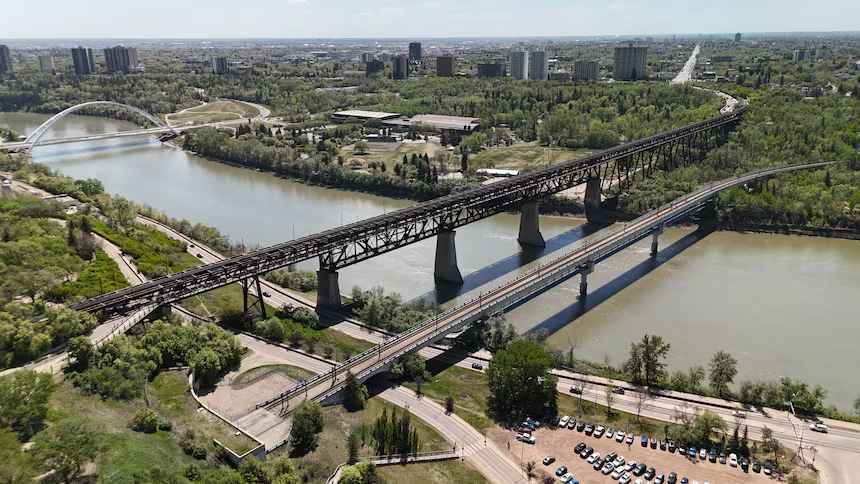 (Built in 1913, the High Level Bridge helped connect Edmonton and Strathcona into one city. One history advocate says preserving it is essential to the city's identity. Sam Martin/CBC) From high-speed rail connections to a new signature landmark for the city, councillors are pondering what Edmonton’s next bridge should look like. The opportunity comes as city administration says the High Level Bridge is approaching end of life, and is too expensive to fix. The City of Edmonton had previously set aside money to rehabilitate the bridge, but it’s in worse shape than initially thought. City staff are now recommending a full replacement. “It feels like it will need to be a mega-bridge,” Mayor Andrew Knack said of the project in an infrastructure committee meeting Monday. Knack said like the current bridge, the replacement will need to accommodate cars, bikes and pedestrians. But he said it should also have a dedicated bus lane as the city builds out a bus rapid transit network. It also comes as the province is set to detail a rail master plan, with plans for a high-speed connection between downtown Edmonton and Calgary. Knack pointed out a new river crossing is an opportunity to build out that infrastructure too. The Ministry of Transportation declined to comment on if a High Level Bridge replacement would be well suited for a high speed rail river crossing. Knack would also like to see the High Level Streetcar preserved in a new plan. It’s a lot to ask of one bridge, he noted. “I'm just wondering about frankly the practicality of a singular … mega-bridge that can actually handle all of that.” The final decision will fall on the next city council, as it's slated for a 2031 budget cycle. In the nearer term, councillors will consider what to do with the also historic low level bridge this fall. The current plan is to replace the south- and north-bound low level bridges and build a replacement for car traffic. 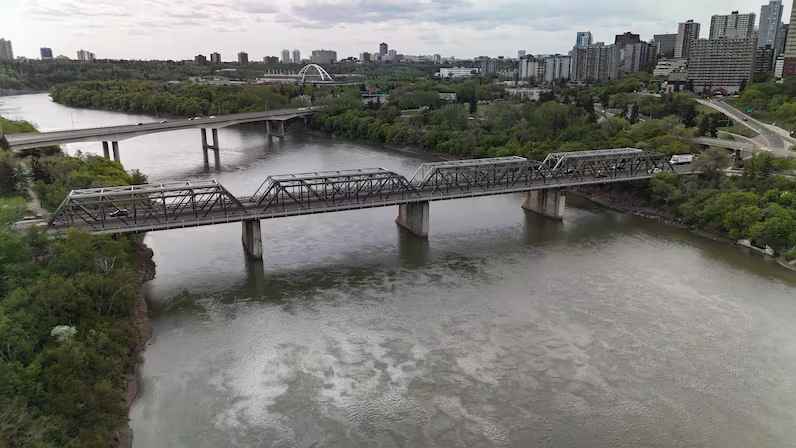 (The northbound Low Level Bridge was built in 1900 and was the first North Saskatchewan River crossing in Edmonton. A southbound bridge was added in 1949. City administration plans to replace them for vehicle traffic, but preserve the north bridge for pedestrians and cyclists. Sam Martin/CBC) Administration does, however, want to keep the 126-year old north bridge for active transportation like bikes and pedestrians. It would also like to simplify the spaghetti junction leading up to it, which city staff described as overbuilt relics of past freeway plans. The current estimate to replace both bridges is $1.3 billion in 2026 dollars. It's a generational investment the city said would put a strain on finances if other orders of government don't chip in. Signature versus functionalCoun. Ashley Salvador said Edmontonians should get a say in what a replacement bridge should look like. “Obviously the High Level is an iconic structure,” she said. “How do we make sure that they're involved so that there is an opportunity to drive design beyond just functionality so that it has the opportunity to be a signature structure?” City staff replied that their estimates aren’t for a design-forward signature bridge akin to the Walterdale. Considering Edmonton’s existing debt, administration went the functional route. Staff said council could reconsider, but a replica-style bridge isn’t recommended because riveted steel structures are increasingly rare and expensive to construct. But not everyone on Monday was on board. Kyle Schole, the vice-chair of the former Edmonton Historical Board, said he’d like to see the High Level preserved and repurposed, noting the bridge is a designated historical resource. “It is the bridge that helped physically and symbolically unite Edmonton and Strathcona into a single city in 1912,” he said. He added the need for rehabilitation was foreseeable and neglected by previous councils. “Cities around the world and across Canada have faced this same challenge and chosen to act strongly. They've adapted historic bridges rather than erase them,” he said. “Once these bridges are gone, they're gone forever. We cannot replicate or rebuild authenticity.” By Emily Williams ---------------- Signature: (This user did not write a signature.) Reply |